
*We want to hear from you*
Please click here to fill out a (~5min) survey. With your input we can make our resources better for you.
Jump to the point of care tools here [Updated Feb 2026 based on Canada College of Medical Geneticists 2025 Position Statement]
|
Bottom line: Reproductive genetic carrier screening is intended to identify reproductive partners, one or both of whom carry a genetic change linked to a severe inherited condition. Ideally, screening is offered in the preconception phase to allow for maximum reproductive choice, but it can be offered at any time during a pregnancy. Current Canadian recommendations suggest that carrier screening for cystic fibrosis, fragile X syndrome, spinal muscular atrophy, hemoglobinopathies, Tay Sachs disease, Canavan disease and familial dysautonomia be offered to every individual, regardless of ethnicity (pan-ethnic screening). These recommendations recognize that, where provincial/territorial programs do not exist, continuing with relevant ethnicity- and family history-based screening is reasonable. GECKO has developed point of care tools to facilitate offering and ordering carrier screening. You can always reach out to your local genetic counsellor or geneticist by calling the local centre or by eConsult where available. |
What is the purpose of reproductive carrier screening?
- To identify reproductive partners, one or both of whom carry a genetic change linked to severe, early-onset conditions.
- To estimate a couple’s chance of having a child affected by such a condition
- For autosomal recessive conditions (e.g. cystic fibrosis, spinal muscular atrophy, Tay Sachs disease, hemoglobinopathies) where both members of a couple are carriers of the same condition, there is a 25% chance in each pregnancy to have a child affected with the condition
- For X-linked conditions (e.g. fragile X syndrome, Duchenne muscular dystrophy, hemophilia A, Fabry disease), if the pregnant partner is a carrier, each pregnancy has a 50% chance of inheriting the X chromosome with the affected gene; 50% of male offspring would be affected, 50% of female offspring would be carriers
- To enable tailored genetic counselling and education, reproductive planning and early pregnancy management options. This includes assessment for early diagnosis, preparation, access to testing, or pregnancy management (e.g. termination) if a pregnancy is found to be at increased risk or affected. Some couples may opt to pursue preimplantation genetic diagnosis to avoid the risk of having an affected pregnancy. Parental genetic test results would be necessary for this option.
When should reproductive carrier screening be offered?
- Ideally when planning a pregnancy (preconception), or as early as possible in a pregnancy
- In the preconception period, it is reasonable to offer carrier screening to one reproductive partner first, and then to the other partner if the first partner has a positive genetic test result.
- In pregnancy, it is reasonable to offer carrier screening to both reproductive partners concurrently.
What are the Canadian recommendations for reproductive carrier screening?
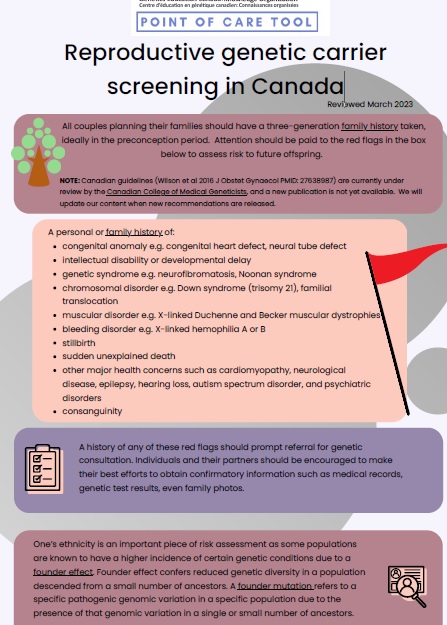
- Take a personal and family health history of both reproductive partners, ideally in the preconception period, with attention to autosomal recessive or X-linked conditions (e.g. bleeding disorders in male relatives, fragile X syndrome). Preconception family history tool
- Offer a discussion about the value and risk of reproductive carrier screening
- Offer pan-ethnic reproductive screening* as per provincial/territorial program guidelines
- The Canadian College of Medical Geneticists recommends that carrier screening for the following conditions be offered to all individuals planning a pregnancy or who are pregnant (at any gestational age)
- Cystic fibrosis
- Fragile X syndrome
- Spinal muscular atrophy
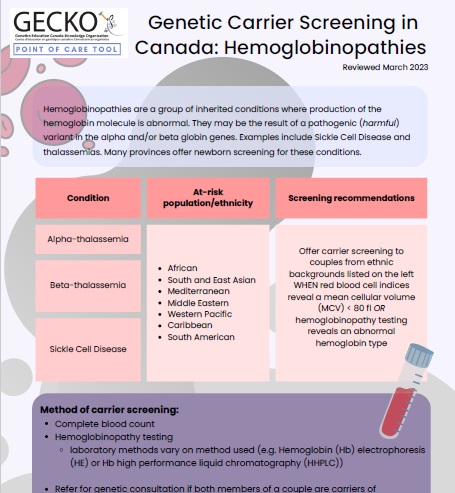
- Hemoglobinopathies
- Tay-Sachs disease, Canavan disease and familial dysautonomia (specific common genetic variants)
- The Canadian College of Medical Geneticists recommends that carrier screening for the following conditions be offered to all individuals planning a pregnancy or who are pregnant (at any gestational age)
- Even when pursuing pan-ethnic carrier reproductive screening, individualized risk assessment (e.g. personal and family history) may result in additional testing being offered *Pan-ethnic carrier screening is offered to all individuals regardless of ethnicity.
- In the absence of a provincial/territorial carrier screening program in your jurisdiction, continue to offer carrier screening based on individualized genetic risk assessment (e.g. based on family history or ethnicity).
- Continue to offer relevant ethnicity-based screening (below) that is available in your jurisdiction. If you are unsure which carrier screening tests are available and funded in your area, and/or how to order this testing, contact your local genetics centre or eConsult.
|
Ethnicity |
Screening to offer |
|
African, South and East Asian, Mediterranean, Middle Eastern, Western Pacific, Caribbean, South American |
|
|
Saguenay Lac-St-Jean (SLSJ) and Charlevoix regions of Québec |
|
|
Cree |
|
|
Aboriginal Manitoba populations |
|
|
Newfoundland populations |
|
|
Families of Amish, Mennonite, or Hutterite background |
|
- Expanded carrier screening (ECS) is genetic testing available for private pay. It screens an individual for broad range of conditions (100+ conditions). In 2016, the Canadian College of Medical Geneticistsand the Society of Obstetricians and Gynaecologists of Canada published an opinion stating “the option of this technology [ECS] should be part of the informed consent process” where it is discussed with and offered to all couples. Some couples may opt to pay out-of-pocket for ECS when they prefer a more comprehensive assessment than what is available through provincially/territorially funded testing.
- Point of care tool: Before ordering ECS (selection tips)
- Point of care tool: After results of ECS (interpretation and next steps)
When do I refer for a genetic consultation?
Consider referral to your local genetics centre if:
- An individual and/or their reproductive partner’s personal/family history is suggestive of a genetic condition
- Carrier screening has revealed that an individual and their reproductive partner are carriers of the same condition
- An individual is a carrier of a genetic condition, and you require support to coordinate carrier testing for the reproductive partner. You may wish to contact your local genetics centre prior to making a referral.
- You are unsure about how to interpret genetic test results
- Note: if results are the product of private pay genetic testing, genetics centres vary in their acceptance of these referrals. Always contact your local genetics centre (by phone or by eConsult) if you have questions. There is often a genetic counsellor on call to help.
What are some additional resources I could use?
Related resources:
Point of care tools:
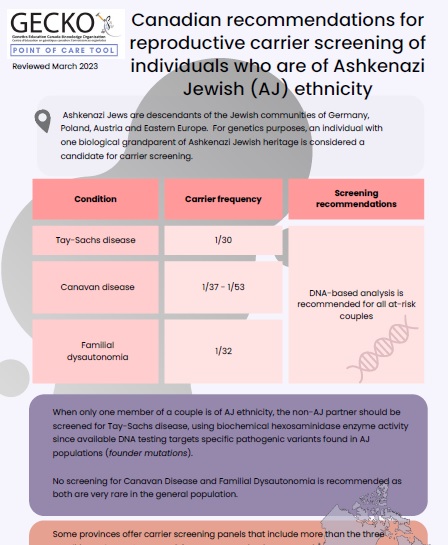
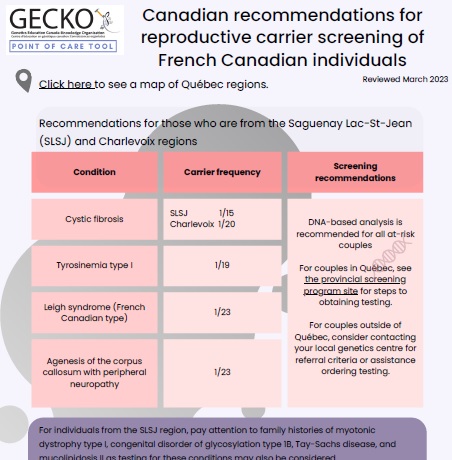
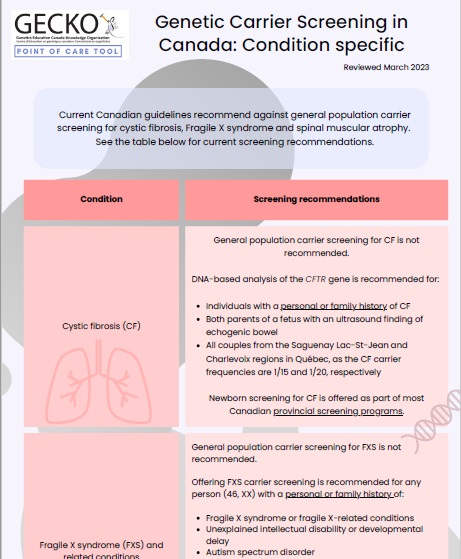
We have developed five (5) point of care tools to assist clinicans in assessing individuals and couples and their eligibilty for carrier screening as per current Canadian guidelines. Download the full suite of tools, those for Ashkenazi Jewish ancestry, French Canadian ancestry, Hemoglobinopathies or Condition specific recommendations (i.e. Fragile X syndrome, cystic fibrosis and spinal muscular atrophy).

-------
Disclaimer:
· GECKO is an independent not-for-profit program that does not accept support from commercial or non-academic entities.
· GECKO aims to aid the practicing non-genetics clinician by providing informed resources regarding genetic/genomic conditions, services and technologies that have been developed in a rigorous and evidence-based manner with periodic updating. The content on the GECKO site is for educational purposes only. No resource should be used as a substitute for clinical judgement. GECKO assumes no responsibility or liability resulting from the use of information contained herein.
· All clinicians using this site are encouraged to consult local genetics clinics, medical geneticists, or specialists for clarification of questions that arise relating to specific patient problems.
· All patients should seek the advice of their own physician or other qualified clinician regarding any medical questions or conditions.
· External links are selected and reviewed at the time a page is published. However, GECKO is not responsible for the content of external websites. The inclusion of a link to an external website from GECKO should not be understood to be an endorsement of that website or the site’s owners (or their products/services).
· We strive to provide accurate, timely, unbiased, and up-to-date information on this site, and make every attempt to ensure the integrity of the site. However, it is possible that the information contained here may contain inaccuracies or errors for which neither GECKO nor its funding agencies assume responsibility.